

By GrowthGen Digital. Updated October 2026. General information, not legal advice.
Short answer
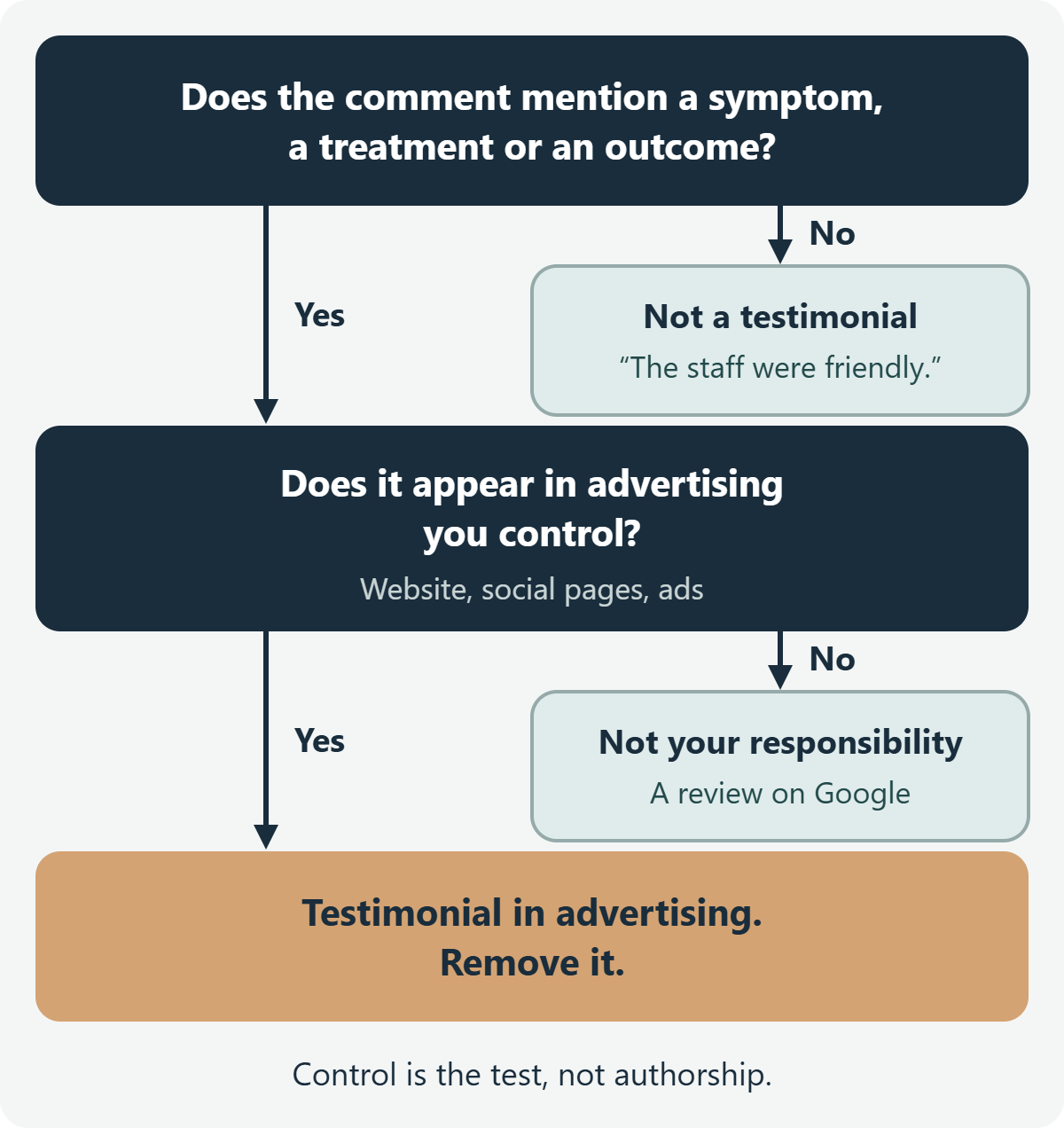
Patients are free to review your clinic on Google, and you are not responsible for reviews on a platform you do not control. The breach starts when you reuse a review about clinical care in advertising you control. Your website, your social pages and your ads all count.
A practice manager pastes five 5-star Google reviews onto the clinic homepage. Each one names a treatment and a result. Nobody at the clinic wrote a word of them. Under the National Law, the clinic now advertises with testimonials.
What does AHPRA count as a testimonial?
A testimonial is a recommendation or positive statement about the clinical aspects of a regulated health service, used in advertising. Section 133 of the National Law bans testimonials and purported testimonials in health service advertising. For the full set of rules, read our guide to AHPRA and TGA marketing compliance.
AHPRA’s testimonial tool names three clinical aspects:
- SymptomThe reason the patient sought treatment
- Diagnosis or treatmentWhat the practitioner found or did
- OutcomeThe result, or the skills and experience of the practitioner
A comment on customer service or communication style, with no clinical reference, is not a testimonial. “The reception team was friendly” passes. “Dr Lee fixed my back pain in two visits” does not.
Are Google reviews of my clinic a breach?
No. AHPRA states advertisers are not responsible for removing testimonials on platforms they do not control. A review on your Google Business Profile sits on Google’s platform. You did not publish it.
Asking patients for honest feedback on Google keeps the review on a third-party platform. Offer no gift or discount in return. An incentivised review is no longer independent feedback.
Where does the breach start?
The breach starts when a clinical review appears in advertising you control. Control is the test, not authorship.
| Action | Allowed? | Why |
|---|---|---|
| Patients post reviews on your Google Business Profile | Yes | A platform you do not control |
| Embed a Google reviews feed on your website | No | You publish clinical reviews in advertising you control |
| Screenshot a review for Instagram, Facebook or an ad | No | Reuse turns the review into your advertising |
| Share or repost a patient’s post about their treatment | No | AHPRA: sharing a comment on a clinical aspect makes it advertising |
| Leave reviews switched on for your Facebook page | Risk | You control the page. AHPRA accepts disabling the reviews function. |
| Show a star rating with no review text | Low risk | AHPRA: a rating symbol is not likely to breach the ban, unless it republishes the reviews behind it |
| Publish a comment about friendly staff or easy parking | Yes | No clinical aspect. It still must not mislead. |
| Edit a review to remove the clinical part | High risk | AHPRA: editing reviews carries a high risk of misleading |
| Publish only your positive reviews | High risk | Selective publishing misrepresents patient feedback |
| Like a patient review of a cosmetic procedure | No | AHPRA’s cosmetic advertising guidelines treat the interaction as using a testimonial |
Who is responsible: the practitioner, the clinic or the agency?
Whoever controls the advertising is responsible. The rules apply to anyone advertising a regulated health service: a person, a business or a corporate entity.
You remain the advertiser when you authorise a third party to publish for you. An agency adding a reviews widget to your website does not move the responsibility to the agency.
How should you reply to a review?
Reply without clinical detail and without confirming the reviewer is a patient. Patient confidentiality applies online.
Reply to a positive review
“Thank you for taking the time to leave feedback.”
Reply to a negative review
“Thank you for your feedback. We take concerns seriously. Please call our practice manager on [number] and we will look into this.”
Leave out the treatment, the outcome and the appointment date.
What to do this week
- Open your homepage, service pages and practitioner pages. Remove quotes, review feeds and video stories about clinical care.
- Check Instagram and Facebook highlights, pinned posts and reels for reposted patient content.
- Switch off the reviews function on Facebook pages you control.
- Check your Meta and Google ads for review screenshots and quoted patients.
- Ask your agency in writing where patient feedback appears in your marketing.
- Keep your Google Business Profile active. Reviews there stay.
AHPRA closes low and medium risk advertising matters once the practitioner corrects the breach. Correct your pages before a complaint arrives.
How do clinics build trust without testimonials?
Replace patient quotes with proof you own:
- Practitioner pagesQualifications, registration and years in practice
- Service pagesWhat happens, who performs it, risks and recovery
- Google Business ProfileServices, hours and photos of your real rooms
- FeesClear fees or fee ranges
- FAQsAnswers to the questions patients ask at your front desk
Patients read reviews on Google. Your website answers the next question they have. See how GrowthGen Digital works with clinics and medical practices.
FAQ
Is a Google review a testimonial under AHPRA rules?
A Google review about clinical care becomes a testimonial in advertising once you reuse it in a channel you control. On Google’s platform, it is patient feedback you are not responsible for.
Am I allowed to embed Google reviews on my clinic website?
No. An embedded feed publishes every review, clinical ones included, on a website you control.
Do I need to delete Google reviews mentioning treatment?
No. AHPRA does not require you to remove, or try to remove, testimonials on platforms you do not control.
Is a star rating on my website allowed?
AHPRA says a rating or award symbol is not likely to breach the testimonial ban, unless it republishes the testimonials behind it.
Do the rules apply to dentists, physiotherapists and psychologists?
Yes. Section 133 covers advertising of every regulated health service, by practitioners and by businesses.
Free compliance scan
GrowthGen Digital scans clinic websites for wording and content AHPRA and TGA rules restrict. Send your website address and you receive the findings by email. No call needed.