
Short answer
You are allowed to advertise a cosmetic clinic in Australia. Two regulators set the limits. AHPRA governs how you advertise the service. The TGA governs references to prescription-only products such as cosmetic injectables. Since 2 September 2025, AHPRA guidelines for higher risk non-surgical cosmetic procedures add rules on images, language, influencers and age.
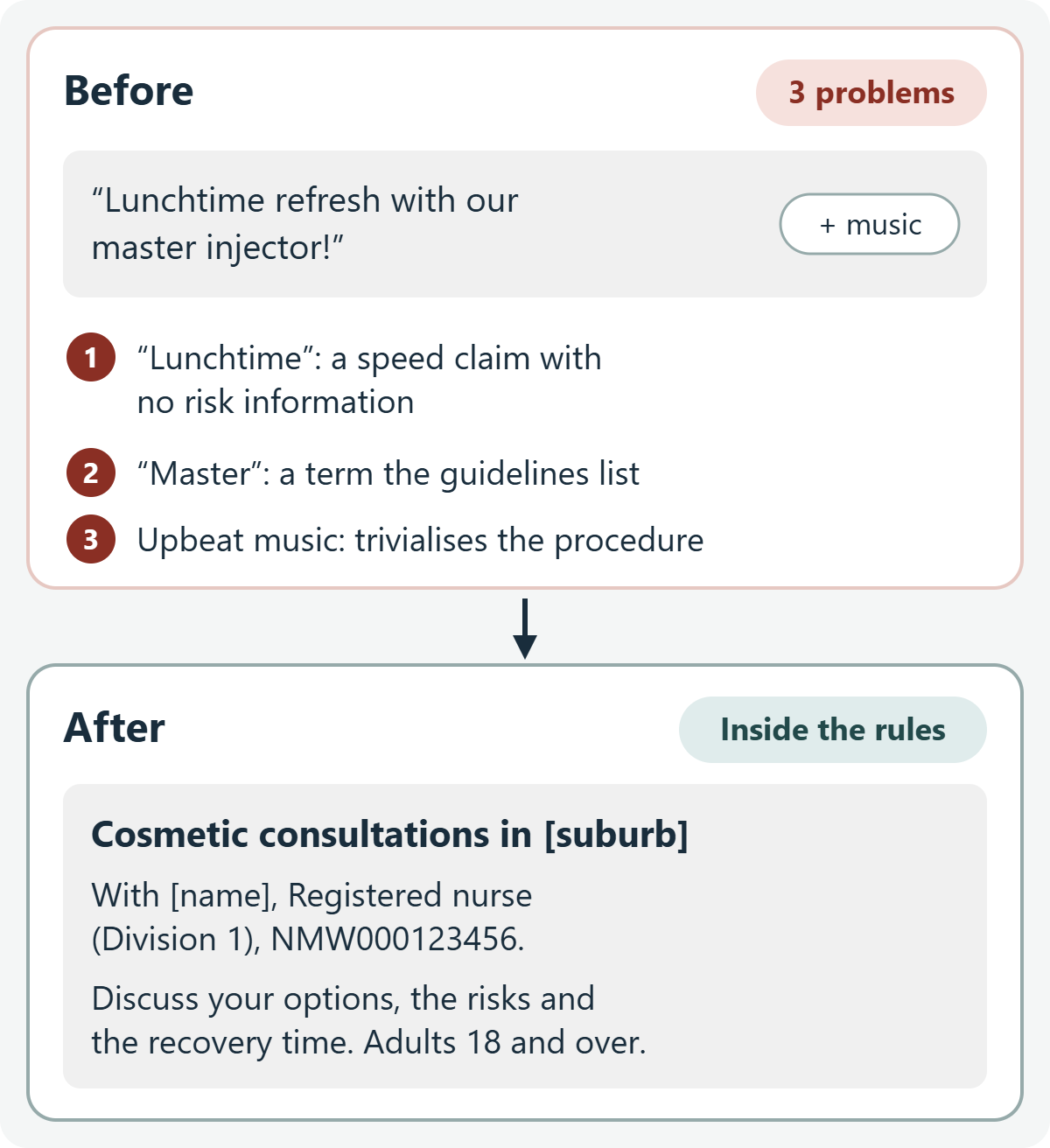
A skin clinic posts an Instagram reel. Upbeat music, a before and after swipe, and the caption “lunchtime refresh with our master injector”. One reel, three problems under the 2025 guidelines: the music, the word “master”, and a speed claim with no risk information.
Which rules apply to a cosmetic clinic?
Three sets of rules apply at once.
| Rule set | Regulator | What it covers |
|---|---|---|
| Section 133 of the National Law | AHPRA and the National Boards | All health service advertising. No misleading claims, no testimonials, no offers without terms, no unreasonable expectation of benefit, no encouraging unnecessary use. |
| Guidelines for advertising higher risk non-surgical cosmetic procedures | AHPRA and the National Boards | Images, language, titles, influencers, risk information and age limits. In effect from 2 September 2025. |
| Therapeutic Goods Act 1989 | TGA | Advertising of therapeutic goods, including prescription-only medicines such as cosmetic injectables |
The rules apply to anyone advertising these procedures: registered practitioners, clinic owners without registration, and businesses. Our AHPRA and TGA compliance guide covers the general rules for every clinic type.
Which procedures count as higher risk?
AHPRA’s examples include botulinum toxin, dermal fillers, injection lipolysis, thread lifts, sclerotherapy, platelet-rich plasma, hair transplants and dental veneers.
The category covers non-surgical procedures to change appearance involving injectables, prescription medicines, or penetration of the skin by chemicals, light, laser, heat or cold.
What wording does AHPRA rule out?
The guidelines name words and themes to keep out of cosmetic advertising. Each row below gives a compliant swap.
| Do not write | Why | Write this instead |
|---|---|---|
| “Master injector”, “sculptor”, “artist”, “queen” | Listed as trivialising terms | “Registered nurse (Division 1), NMW000123456” |
| “The best version of yourself”, “a happier you” | Body image language named in the guidelines | A plain description of the procedure and who performs it |
| “Quick”, “easy”, “safe”, “simple” | Minimising words need clear risk information with them | “Appointments take about 30 minutes. Read the risks and recovery details before you book.” |
| “Painless” | Pain varies by person | “Discomfort varies. Ask your practitioner what to expect.” |
| “Flawless”, “youthful”, “perfect” | Promotes unrealistic body ideals | What the procedure does, and its limits |
| “Specialises in”, from a practitioner without specialist registration | Implies specialist registration | “Works primarily in” or “substantial experience in” |
| “Our patients love their results”, plus reviews | Testimonial | Qualifications, registration and years in practice |
The guidelines also rule out music, dancing, singing and comedic comments in procedure content, emojis on images, sexualised images, and lifestyle shots at the beach, pool or bedroom.
What are the rules for before and after photos?
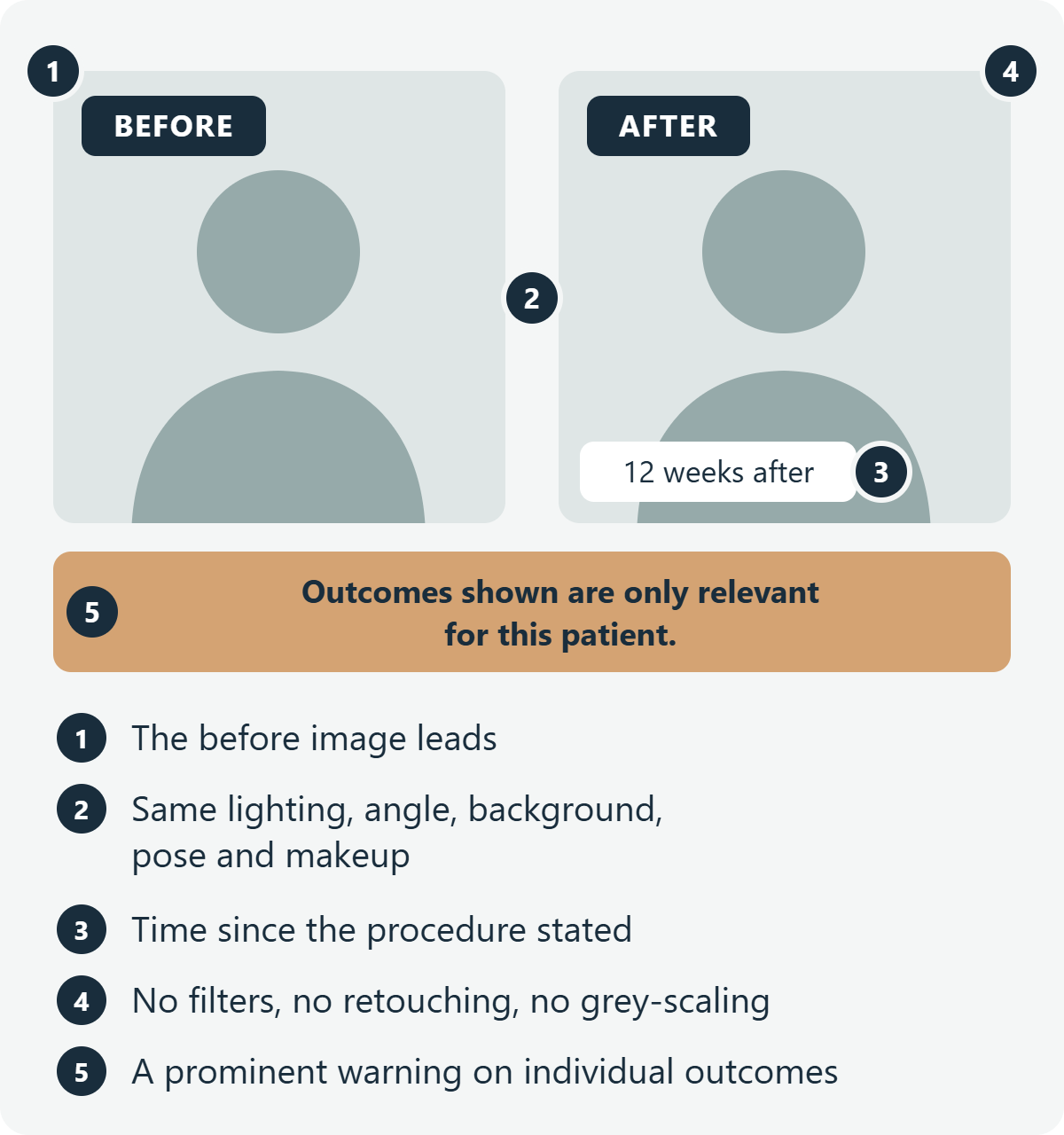
Before and after photos are allowed under strict conditions. Check every image against this list:
- Both images show a real patient of the practitioner advertised
- The before image, or a combined image, appears first or most prominently
- Lighting, camera angle, background, framing, posture, clothing and makeup match as closely as possible
- The after image states how long after the procedure it was taken
- No filters, no retouching, no grey-scaling
- A prominent warning says the outcomes shown are only relevant for this patient
- No person under 18 appears
- The patient gave separate, informed consent for image use
- You remove the images promptly when a patient withdraws consent
Are influencers and offers allowed?
You are responsible for content an influencer or ambassador publishes for your clinic. Their story about a procedure is a testimonial, and testimonials are banned. Our guide to Google reviews and AHPRA covers the testimonial rule in full.
Section 133 requires any gift, discount or inducement to state its terms and conditions. Offers must not encourage unnecessary treatment. AHPRA’s FAQ flags bulk purchase discounts for this reason.
Who are you allowed to target?
Adults only. Advertising aimed at under 18s is banned, and images of people under 18 must not appear in advertising for these procedures. Set your ad audiences to 18 and over on every platform.
What does the TGA add?
The TGA regulates advertising of therapeutic goods, including prescription-only medicines such as cosmetic injectables. Its guidance for health services says it is best not to refer to any therapeutic goods used to deliver the service.
In practice: advertise the consultation and the concern, not the product.
AHPRA’s guidelines add one more point: price lists for procedures involving therapeutic goods must meet TGA requirements.
What does a compliant cosmetic clinic ad look like?
This template follows the rules above. It is a starting point, not an approved ad.
- Headline
- “Cosmetic consultations in [suburb]”
- Body
- “Book a consultation with [name], Registered nurse (Division 1), [registration number]. Discuss your concerns, your options, the risks and the recovery time. Adults 18 and over.”
- Image
- Your real treatment room or your practitioner. No patient images. No emojis.
- Landing page
- Procedure information, risks, recovery, practitioner details and fees
What to do this week
- Search your website and captions for the words in the table above. Replace each one.
- Add registration details to every practitioner mention.
- Check every before and after image against the checklist. Remove the ones failing it.
- Remove music, emojis and emotional reaction shots from procedure content.
- Delete reposted patient stories and influencer testimonials.
- Set ad audiences to 18 and over.
- Add risk and recovery information to every procedure page.
How do cosmetic clinics grow inside these rules?
The rules remove hype and leave information. Patients look for information before they book.
- Consultation pagesOne page per concern, each ending in a consultation booking
- Practitioner pagesName, registration, training and years in practice
- Risk and recovery contentRequired by the guidelines, and the same questions patients type into Google and ChatGPT
- Google Business ProfileComplete, current, with photos of your rooms
- Search adsConsultation terms, sent to pages meeting the rules
See how GrowthGen Digital approaches cosmetic clinic marketing.
FAQ
Are before and after photos banned for cosmetic clinics?
No. They are allowed under conditions: real patients, matched images, no editing, the before image first, and a warning on individual outcomes.
Are cosmetic clinics allowed to use influencers?
You are responsible for everything an influencer publishes for your clinic. Influencer testimonials about a procedure are banned.
Do the guidelines apply to a clinic owner without registration?
Yes. They apply to anyone advertising higher risk cosmetic procedures performed by registered practitioners, including businesses.
When did the cosmetic advertising guidelines start?
2 September 2025. The Medical Board of Australia announced them on 3 June 2025.
Free compliance scan
GrowthGen Digital scans cosmetic and skin clinic websites for wording and images AHPRA and TGA rules restrict. Send your website address and you receive the findings by email. No call needed.
Sources
- AHPRA: Advertising higher risk non-surgical cosmetic procedures
- Medical Board of Australia: new cosmetic procedure guidelines, 3 June 2025
- AHPRA: Guidelines for advertising a regulated health service
- AHPRA: Advertising frequently asked questions
- TGA: Advertising health services involving therapeutic goods